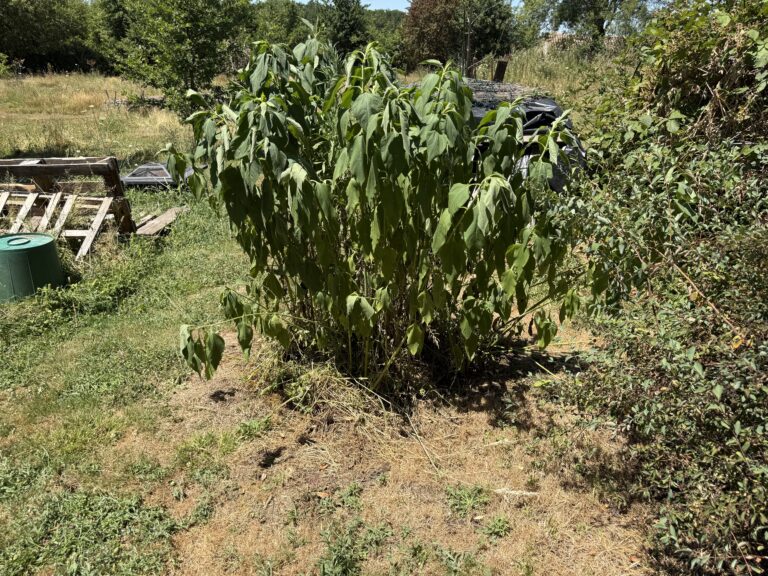
One thing in Permaculture that really inspires me, is the principle of observation. If something goes wrong, for example a plant dies, there is often something wrong in the system, it’s something you can fix, or the plant is just not where it is supposed to be. For example: somebody gifted me Hydragena and curly willow clippings. But both are really struggling with the 40+ degrees, and no rain. You can water them everyday, but if they eventually just give up, they were in a place that isn’t favourable to them. Maybe a change in the system can solve this. But if you have no means to change the system (in time), than the plants were just a design fault, and they probably shouldn’t have been there. On a bigger scale this counts for the current forest fire season too. Never before have the fires in Spain and France been so intense and large in scale. We can blame it on climate change, greenhouse gasses, but in reality there is often much more going on. And instead of just being very complex and diffcult to solve, sometimes there are a few obviouses that can quite simply be solved. It starts with honest observation, one of the basic principles in Permaculture. And than seeing if there is anything that you can learn from it.
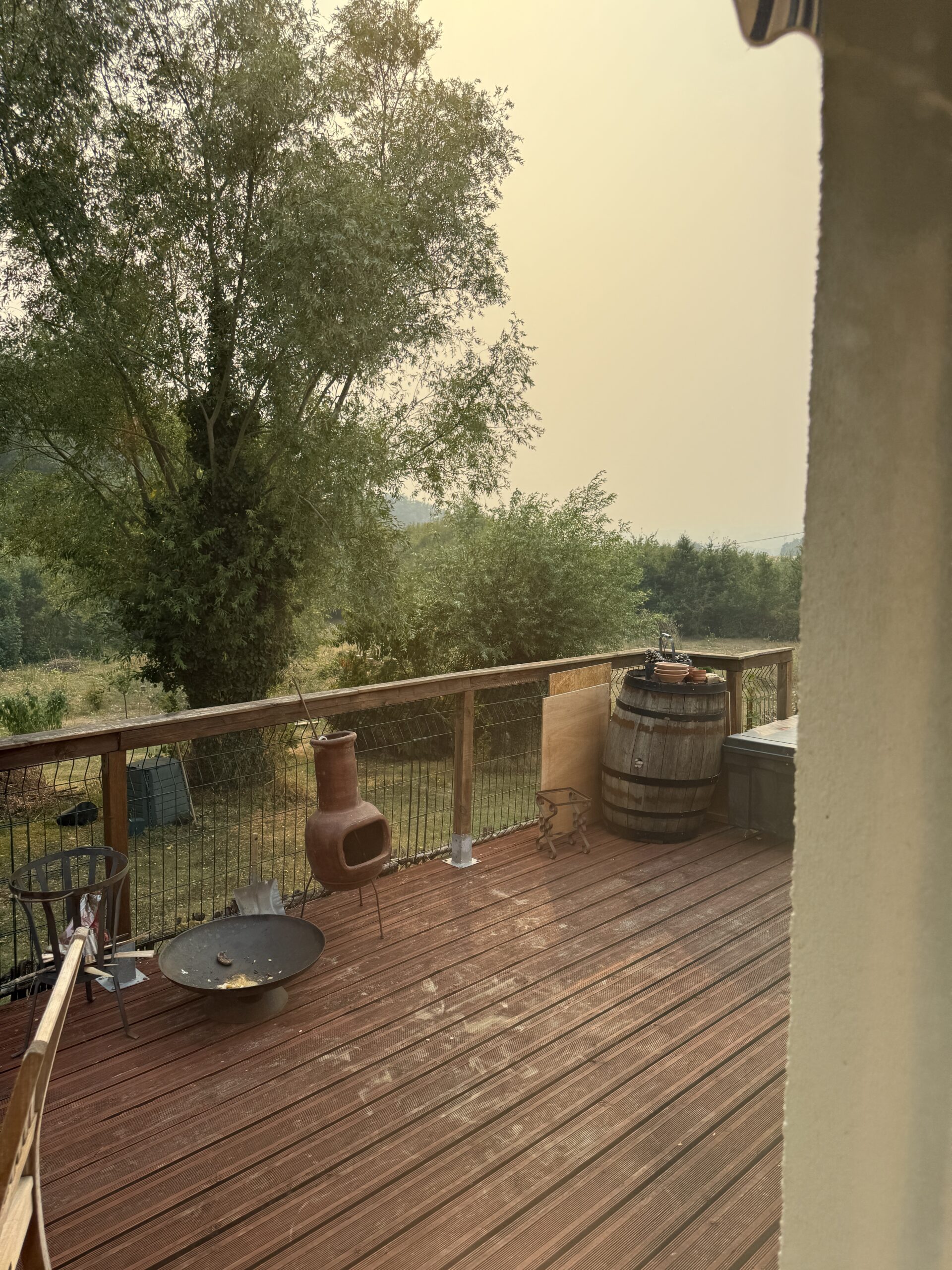
Let’s zoom into Bordeaux and the coastline area. The region west from us. Still a one and half hours drive away from us, but nevertheless, at Val de Foy we felt it’s devastating reality, especially when the toxic fumes covered our region. The images from the Bordeaux region over the past weeks have been heartbreaking. Forests consumed by flames. Villages evacuated. Firefighters working around the clock, often at great personal risk, to contain fires that seem almost impossible to control. Their courage deserves nothing but admiration.
But while our eyes are fixed on the flames, perhaps we are forgetting to ask a more fundamental question.
What is it that is actually burning?
Most people see a natural forest falling victim to extreme weather. Some say it’s the result of climate change. Some will say it’s the product of some idiots lighting the fires. Yet that is only part of the story.
I learned from having visited the area where the monoculture of needle pines stood out, and closely build recreational homes, and having read some things about the history of the area, that in the middle of the nineteenth century, the landscape stretching from Bordeaux to the Atlantic coast looked very different. Much of what is now known as Les Landes was an extensive mosaic of wetlands, heathlands and marshes. It was a living ecosystem that stored water, supported remarkable biodiversity and possessed a natural resilience built over centuries.
Under Napoleon III, that landscape was transformed. Vast areas were drained and planted with maritime pine, creating one of Europe’s largest commercial forests. Diversity gave way to monoculture. A landscape shaped by ecology became one shaped by economics.
Later, another layer was added. The coastline became one of France’s favourite holiday destinations. Campsites, holiday homes, roads and beach resorts multiplied. What had already become a production landscape also became a landscape of consumption.
And now it burns.
Of course, extreme heat and prolonged drought are major drivers. Climate change has turned summers into longer, hotter and drier seasons. There also appears to be a growing number of deliberately started wildfires. Whether motivated by financial gain, attention, revenge or simple recklessness, these acts are deeply disturbing. Many fires seem to originate close to major roads, where human activity constantly intersects with vulnerable landscapes. And then there is the blame that falls on the government, who hadn’t done enough to maintain the Canadairs, and didn’t have enough means to help fight the fires.
But even these ingredients don’t explain a catastrophe of this scale.
A single spark becomes a disaster only when it lands in a landscape that has been made vulnerable.
Perhaps that is the most uncomfortable truth of all.
We often describe these events as natural disasters, as though nature itself has turned against us. Yet the forests that are burning are, to a large extent, forests that we designed. The landscapes are our creation. The climate in which they now struggle is increasingly one of our making as well.
Recently, an image went viral showing holidaymakers calmly sitting in folding chairs while enormous clouds of smoke rose in the distance. Across newspapers and social media, the photograph became a symbol of denial. People asked how anyone could simply sit and watch while the world was burning.
But the picture invites us to look at the wrong people. They were captured in their swimming trunks, in their holiday chairs, because that’s what they came for. They simply had no other option than to watch the developments, in the heat, from the spot that they booked for the week. We don’t know if they were quietly thinking whether it would help the situation if they’d pack and leave back home.
Perhaps the picture is more about the debate that it triggers, and all the people involved behind this scene. How different are the people condemning the people in the picture, really?
We analyse the photograph, condemn the apparent indifference and share thoughtful essays about how it should have been done different. Then we return to our own comfortable lives and count the days until our next holiday flight. At the very moment Europe is enduring record-breaking temperatures, airports are breaking records too.
The contradiction is difficult to ignore.
This is not about blaming tourists. Nor is it about blaming a deliberate or ignorant act that lighted the fire, or the government.
It is about recognising ourselves, our role, and the choices that we can make.
I write these words knowing that I, too, am part of the same system. I travel. I value basic comforts. I have made many climate unfavourable choices. That is precisely why this conversation matters. It is not about pointing fingers. It is about questioning habits that have become so normal we rarely notice them anymore.
I think, as a learning society, we should stop accepting vast monocultures as inevitable economic choices, and begin restoring mixed forests that are naturally more resilient to drought, disease and fire. Perhaps some of the wetlands that once defined this landscape should once again be allowed to store water instead of being drained as efficiently as possible.
Perhaps we should also rethink the way and timeframes in which we travel.
The fires around Bordeaux are not an isolated tragedy. Today it is Les Landes. Tomorrow it will be somewhere else. We can continue treating every wildfire as another unfortunate event, or we can recognise them for what they increasingly are: consequences of landscapes we simplified, climates we destabilised and lifestyles we have been reluctant to reconsider.
Perhaps the forests are not only asking us how they should be rebuilt.
Perhaps they are asking how we intend to rebuild ourselves. I think we silently know the answer. It is imminent that we start pulling the lever, and truly make some fundamental changes. There is still time, but it is running out. At Val de Foy we hope to inspire and help people rethink their choices, purely by observation, and understanding what is needed to nudge nature into restoration.